
"Sleepus Interruptus" (Sleep Interrupted)
A Nightly Sequel Nobody Asked For

Hello, Health Enthusiasts!
Welcome to this week’s installment of our Informative Health Blog, lovingly written by yours truly and posted every Saturday morning, my attempt to keep you informed (and laughing a little) while talking about serious stuff — even when it involves your plumbing. If health blogs aren’t your thing, you can easily opt out. But if there’s a topic you’d love to see covered, drop me a line.
Stay healthy, stay curious, and as always, thanks for reading!
Warm regards,
Andrew Siegel MD
Sleep Interrupted: A Nightly Sequel Nobody Asked For
There’s a particular kind of loneliness that exists only at 3:17 a.m. It’s not the peaceful, poetic kind you imagine when you say, “I’d love some quiet time.” No -- this is the wide-awake, staring-at-the-ceiling, negotiating-with-your-own-brain kind. The house is silent. The world is asleep. Even your phone, for once, is not demanding anything from you. And yet… your brain has decided it’s time to host a TED Talk. Welcome to middle-of-the-night insomnia. This issue is not uncommon, occurring in one of five adults, and more prevalent as we get older.
I know it well. I am a champion at falling asleep, something I am able to accomplish typically in a matter of seconds. However, staying asleep is another story entirely. This morning I awakened at 2:43 and could not get back to sleep. Granted, I was exhausted the evening before and fell soundly asleep on the floor of the living room while trying to watch Rooster on Max and then The Pitt on Hulu, missing both episodes in their entirety. I lumbered up to bed around 9 o’clock and fell asleep instantly. And now as I sit here writing, I am glassy-eyed, weary, and clearly sleep-deprived. Like jet lag, this impairment is unhealthy on so many levels.
Why You Wake Up (Even If You’d Rather Not)
Our sleep isn’t one long, smooth glide into oblivion. It’s cycles. And somewhere in the early morning hours, your body naturally drifts into lighter sleep. In fact, waking briefly during the night is completely normal -- many people do it several times and simply don’t remember.
But here’s the catch: some of us wake up… and stay up. Why? There isn’t just one cause. Middle-of-the-night insomnia is more like a committee of bad ideas:
Being a light sleeper -- I’m guilty of this.
Wacky dreams -- This, too.
Stress and anxiety -- The classic culprit. Your brain finally has quiet, so it fills the void with thoughts.
Alcohol -- Helps you fall asleep, then abandons you at 2–3 a.m. like a bad friend.
Caffeine -- Still hanging around from that “harmless” afternoon coffee.
Eating a big meal late -- This is actually a topic for a future blog. Clearly not good for sleep health.
Urinary urgency -- Particularly relevant if you are over 40.
Temperature, light, noise -- Your body is pickier at night than a toddler at dinner.
Your internal clock -- Your circadian rhythm actually makes sleep lighter at certain times.
Body aches and pains -- These may be subconsciously disturbing your sleep
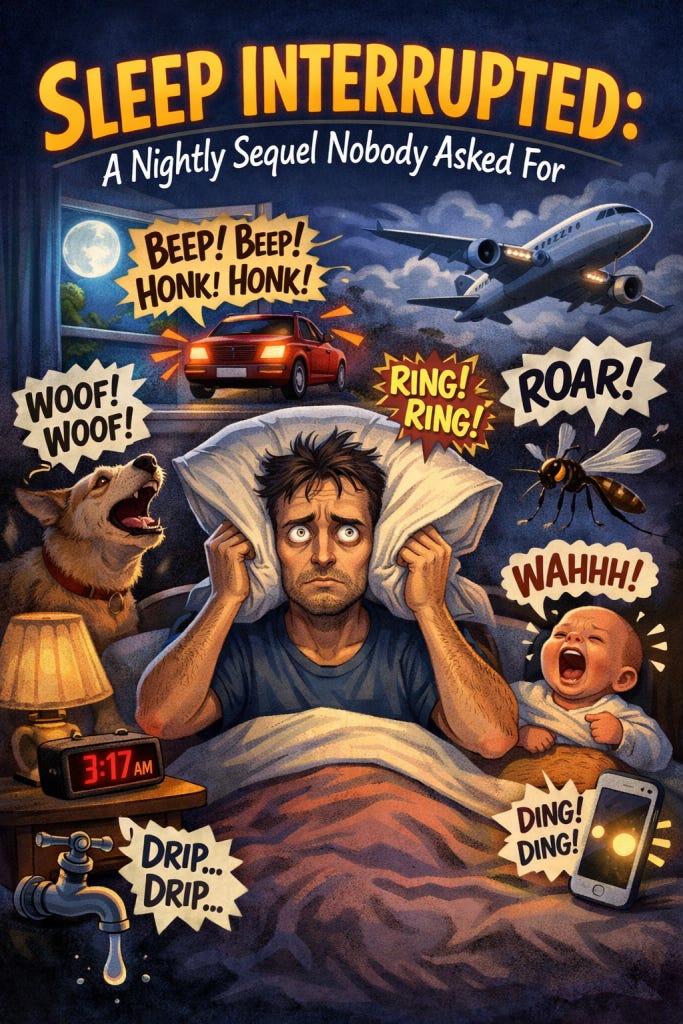
And the truth is that trying too hard to fall back asleep is counterproductive.
The Counterintuitive Truth: Sleep Is Not a Skill
If you take one thing from this, it’s this: Sleep is not something you can force. The harder you try, the worse it gets.
Lying there thinking “I must fall asleep right now or tomorrow is ruined” is like trying to fall asleep during a fire drill. Your brain hears: “Emergency. Stay awake.”
What Actually Helps (From Someone Who’s Been There)
Let me save you years of trial and error.
1. Stop checking the clock
Nothing good has ever come from learning it’s 3:17… then 3:42… then 4:06. It increases stress and alertness.
2. If you’re awake, change the scene
After 15–20 minutes or so, get out of bed. Sit somewhere dim. Read something boring. This isn’t failure -- it’s strategy. It retrains your brain to associate bed with sleep, not frustration. If it’s reasonably close to normal wakeup time, I will at times throw in the towel and use that time productively by heading down to my basement for a workout (as opposed to my typical exercise time late in the afternoon).
3. Try “gentle distraction”
Mentally list random, unrelated things (banana… ladder… blue car…). “Cognitive shuffling” mimics the natural scattered, pre-sleep state of the brain as it drifts into sleep. This mental exercise can help you fall asleep by distracting the brain from anxious, racing thoughts with neutral, random imagery.
4. Breathe like you mean it
The 4-7-8 is a simple technique (inhale for 4 seconds, hold your breath for 7 seconds, exhale for 8 seconds) that calms you by activating the parasympathetic nervous system. This is genuine and not just Instagram hype. Repeat as many times as necessary. At the end of each exhale, I feel a wave of exhaustion coming on and try to latch onto it.
5. Advil Dual Action This is a combo of ibuprofen and Tylenol and can suppress any pain you may be experiencing, whether conscious or not. It has also been shown to reduce nighttime urination, which clearly can help you stay asleep.
6. Last resort: my friend “Pam” These are prescription medications of the benzodiazepine family that are potentially addictive and should be used sparingly, if at all. They include diazepam, temazepam, lorazepam, alprazolam (not quite a “pam” but close enough), etc. When used on a particularly bad night, they can be of great benefit. However, they are habit forming and can potentially leave you fatigued in the morning.
7. Don’t “make up” sleep the next day
No sleeping in, no heroic naps. It feels cruel, but it rebuilds your natural sleep drive.
The Most Reassuring (and Annoying) Truth
Here it is: Even if you don’t fall back asleep, you will be okay. Your body is more resilient than your 3 a.m. brain would have you believe. Quiet rest -- even awake -- still has value. And paradoxically, once you stop catastrophizing the night, sleep tends to come back.
When to Actually Worry About It
If this is happening frequently and affecting your days, it’s worth getting checked. Conditions like sleep apnea, depression, or medical issues can play a role. But for many of us? It’s just the brain… being a little too enthusiastic in the middle of the night.
Final Thought
If you find yourself awake tonight at 3 a.m., staring into the existential void of your ceiling:
You are not broken.
You are not alone.
And most importantly -- This is a terrible time to make life decisions.
Roll over. Breathe. Maybe think about bananas and ladders. Your 8 a.m. self will thank you.
Wishing you the best of health,
Andrew Siegel, MD
Dr. Andrew Siegel is a physician and urological surgeon who is board-certified in urology as well as in female pelvic medicine and reconstructive surgery. His mission is to “bridge the gap” between the public and the medical community.
He is an Assistant Clinical Professor in the Department of Urology at Hackensack Meridian School of Medicine and is a Castle Connolly Top Doctor New York Metro Area, Inside Jersey Top Doctor and Inside Jersey Top Doctor for Women’s Health. He is a urologist at New Jersey Urology, a Summit Health Company.
Dr. Siegel is the author of several books. The second edition of his prostate cancer book is available in print and Kindle formats at Amazon: Prostate Cancer 20/20: A Practical Guide to Understanding Management Options for Patients and Their Families. The audiobook version is available at Amazon: Prostate Cancer 20/20 Audiobook.
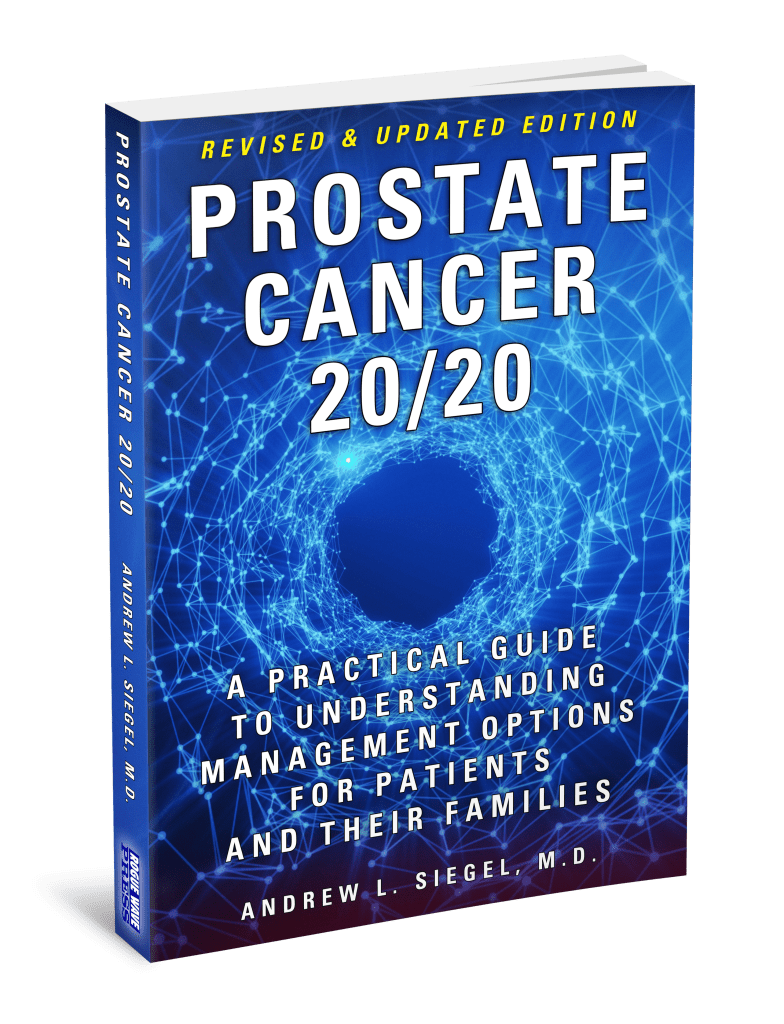

Video trailer for Prostate Cancer 20/20
Preview of Prostate Cancer 20/20
Andrew Siegel MD Amazon author page
Dr. Siegel’s other books:
THE KEGEL FIX: Recharging Female Pelvic, Sexual, and Urinary Health
MALE PELVIC FITNESS: Optimizing Sexual and Urinary Health
PROMISCUOUS EATING: Understanding and Ending Our Self-Destructive Relationship with Food
Thank you, Dr. Siegel for this information which I have experienced. You are right that sometimes you’re not tired enough you sleep a couple of hours and you wake up in the middle of the night and then later on it’s very hard to fall asleep. but we tolerated and make the best of it. Wish you and your family happy passover!